Velocity despiking: Difference between revisions
mNo edit summary |
|||
| Line 21: | Line 21: | ||
===Filter based methods=== | ===Filter based methods=== | ||
This category of methods is quite common in the literature and have been reviewed extensively by others <ref name="GoringNikora" | This category of methods is quite common in the literature and have been reviewed extensively by others <ref name="GoringNikora";name="Starkenburg"/>. | ||
[[File:Smoothed velocities.png|thumb|none|400px|Example velocities before and after smoothing. Filter-based despiking methods use the difference between these two signals to identify spikes.]] | [[File:Smoothed velocities.png|thumb|none|400px|Example velocities before and after smoothing. Filter-based despiking methods use the difference between these two signals to identify spikes.]] | ||
Revision as of 20:21, 24 November 2021
Overview
Any measured signal may be contaminated by spikes. These spikes are typically short-lived and transient, which result in sudden change in the measured velocities.
Spikes in velocities measured by acoustic-Doppler velocimeters can result from aliasing of the Doppler signal, in particular when pulses become contaminated by reflecting from complex objects and boundaries [1]. These spikes must be removed because they can alter quite dramatically the velocity spectra, which is then used for fitting inertial subrange model.
-
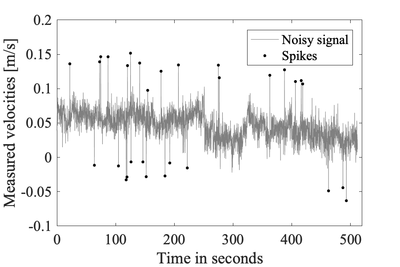
Example velocities measured by an acoustic-Doppler velocimeters -
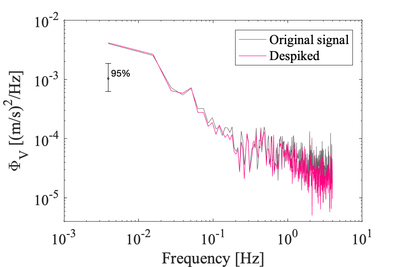
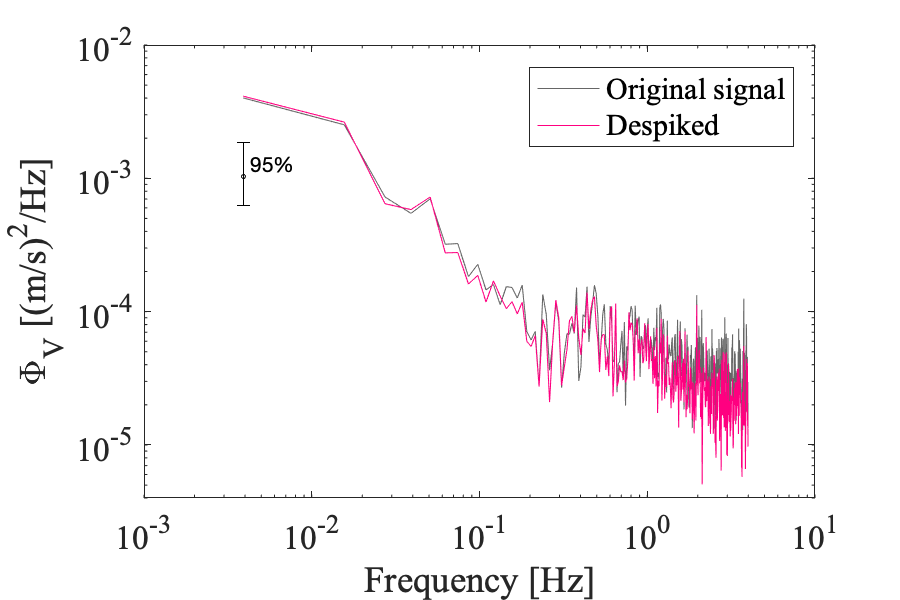
Example velocity spectra before and after removing spikes. The variance of the despiked signal has reduced by 12% even though there were 30 spikes


Despiking methods
Several techniques exist for despiking. The most used with acoustic-Doppler velocimeters are the phase-space thresholding techniques [1]. Other techniques currently being investigated by the subgroup are those used in atmospheric turbulence studies [2], in particular the median filter despiking technique [3], which derives its threshold for identifying spurious spikes from the data itself.
Filter based methods
This category of methods is quite common in the literature and have been reviewed extensively by others [1].

Phase-space thresholding methods
Elaborate a bit? Or include information in a separate page
Notes
- ↑ 1.0 1.1 1.2 D. G. Goring and V.I. Nikora. 2002. Despiking Acoustic Doppler Velocimeter Data. Journal of Hydraulic Engineering. doi:10.1061/ASCE0733-94292002128:1117
- ↑ D. Starkenburg, S. Metzger, G.J. Fochesatto, J.G Alfieri, R. Gens, A. Prakash and J. Cristobal. 2016. Assessment of Despiking Methods for Turbulence Data in Micrometeorology. J. Atmos. Oceanic Technoly. doi:10.1175/JTECH-D-15-0154.1
- ↑ F.V. Brock. 1986. A nonlinear filter to remove impulse noise from meteorological data. J. Atmos. Oceanic Technoly. doi:10.1175/1520-0426(1986)003,0051:ANFTRI.2.0.CO;2